
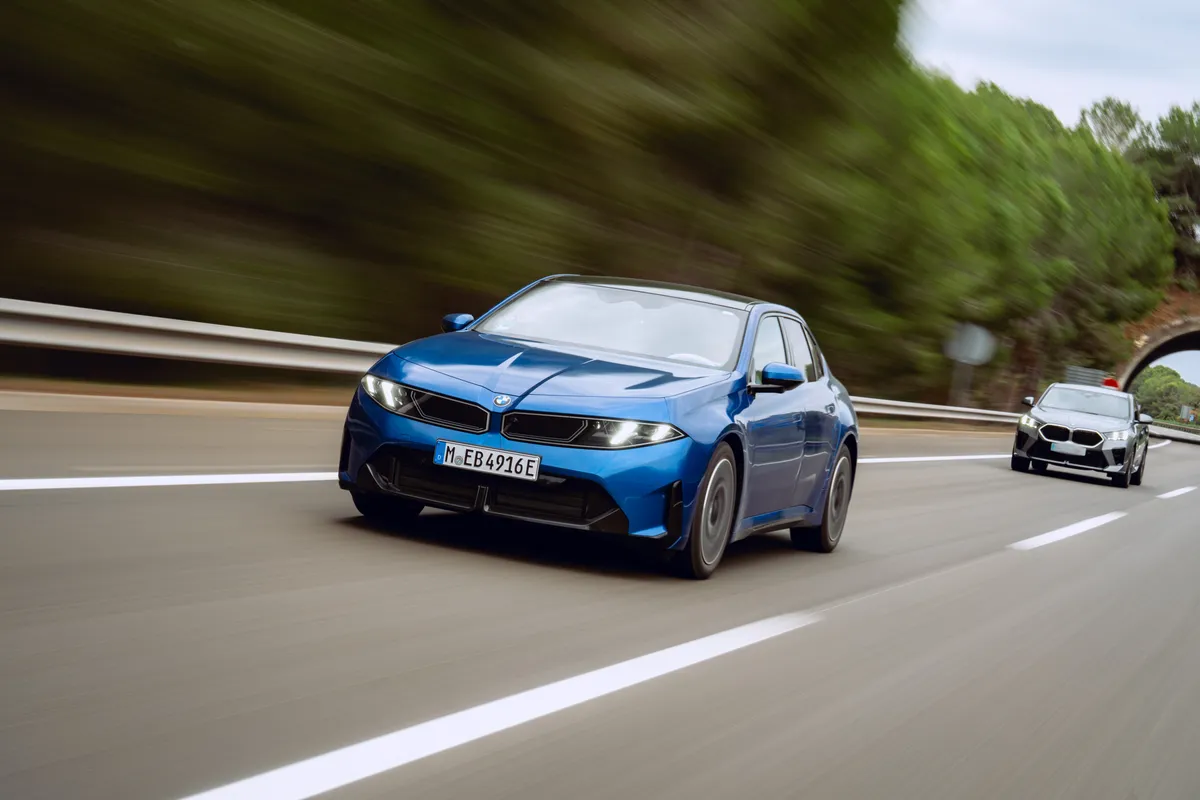
BMW Group says a standard-production i3 50 xDrive, driven at all times by one engineer from its EfficientDynamics team, has completed the Paneuropeana route. The route runs from the North Cape, the northernmost point of mainland Europe you can drive to, to Tarifa, the southernmost, and crosses eight countries. The car was plugged in for 2 hours, 45 minutes and 54 seconds in total, and averaged 12.5 kWh/100 km.
BMW says that beats the previous record, set in 2017, by more than seven hours. The company’s headline number is the charging time. Its efficiency figures may say more about the car.
The run in BMW’s figures
| Measure | BMW figure |
|---|---|
| Distance | 5,886.7 km, North Cape (Norway) to Tarifa (Spain) |
| Countries crossed | 8 |
| Driving time | 3 days, 2 hours, 41 minutes |
| Average speed | 79.7 km/h |
| Total charging time | 2 h 45 min 54 s, at public DC chargers only |
| Average charging power | 275 kW |
| Average consumption | 12.5 kWh/100 km |
| Official WLTP consumption | 18–13.4 kWh/100 km |
| Battery (usable) | 108.7 kWh, cylindrical cells, 800 V |
| Maximum DC charging | Up to 400 kW |
| Wheels on the run | 19-inch M Aerodynamic |
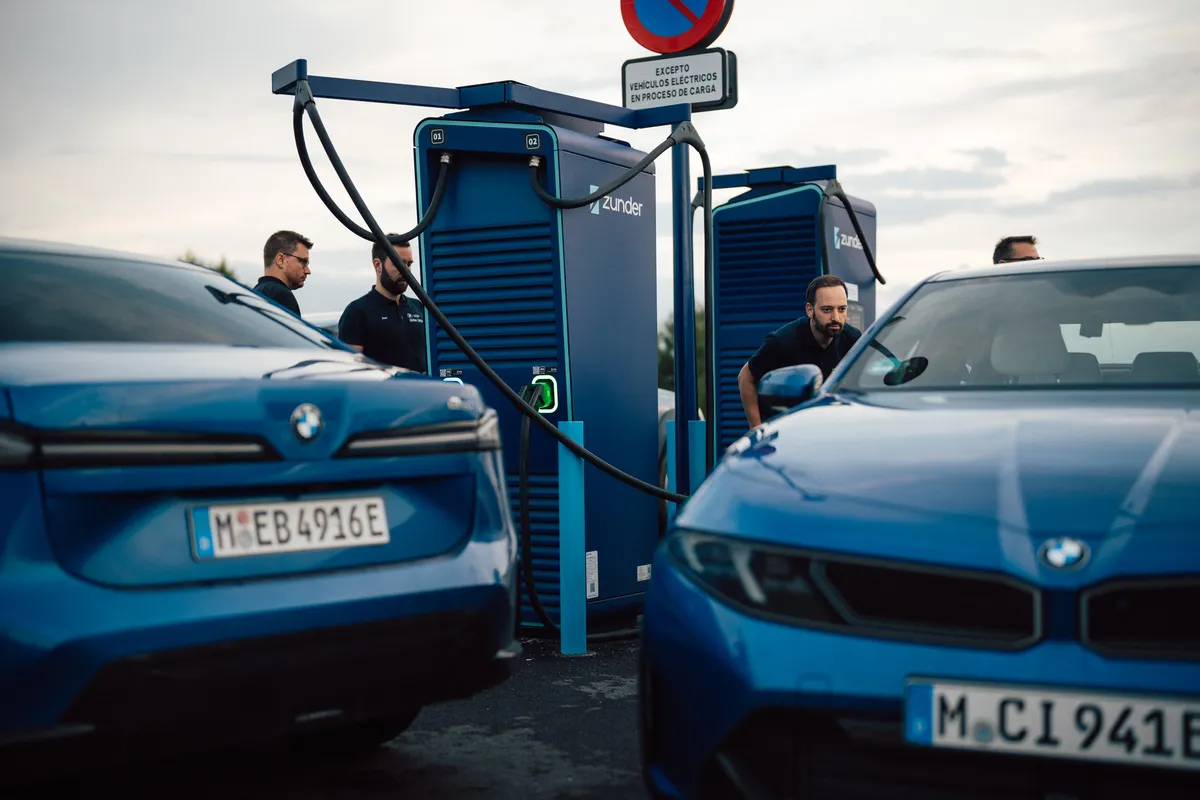
The challenge fixes the checkpoints but not the charging stops. That means the team chooses where to charge between them, and plans around weather and traffic. BMW says an identical i3 and an iX3 50 xDrive went along as support vehicles. It also says all three cars had the same hardware and software as customer cars.
What the numbers imply
BMW does not break the run down stop by stop. But its totals are enough for some useful arithmetic. These are our calculations from BMW’s published figures:
- About 35 km of driving per minute of charging. 5,886.7 km over 165.9 minutes plugged in works out at about 2,130 km for every hour on a charger.
- Charging took about 3.7% of the driving time. That is 165.9 minutes against roughly 4,481 minutes behind the wheel.
- The trip used about 736 kWh. At 12.5 kWh/100 km, that is the same as about 6.8 full charges of the 108.7 kWh usable battery.
- The charging figures and the consumption figures roughly agree. At an average of 275 kW, 2 h 45 min 54 s adds up to about 760 kWh. That is a little more than the 736 kWh the car used. A gap like that is what you would expect from charging losses and different start and finish battery levels. BMW publishes neither, so this is a sense check, not a measurement.
- A typical 10 minutes on a charger was worth about 365 km at this pace. At the 275 kW average, 10 minutes adds about 46 kWh. BMW’s own claim for the car is up to 423 km of WLTP range in 10 minutes, which assumes the best part of the charging curve.
- On a full battery, this driving would cover about 870 km. That is 108.7 kWh at 12.5 kWh/100 km. BMW’s maximum WLTP range for the i3 50 xDrive is 912 km.
The 12.5 kWh/100 km average is at the very bottom of the car’s official WLTP range of 18–13.4 kWh/100 km, and a little below it. Over almost 6,000 km, on motorways, country roads and through towns, that is the most impressive figure in BMW’s release.
Why your road trip would look different
This was a planned efficiency run, not a normal holiday drive. A few things worked in the car’s favour:
- Speed and driver. The 79.7 km/h average includes towns and country roads, and the car was driven by an efficiency engineer. Faster motorway driving uses a lot more energy.
- Charger choice. Choosing where to charge let the team plug in where chargers were fast and the battery was in the best part of its charging curve. Most drivers stop when it suits the trip.
- Specification. BMW quotes a 0.21 drag coefficient, which makes this its most aerodynamic car so far. It also says the tyres have 14% lower rolling resistance than the threshold for an ‘A’ efficiency label, and the car ran on aerodynamic 19-inch wheels.
For constant highway speeds, the closest independent result we have for the same Gen6 hardware is Bjørn Nyland’s test of the BMW iX3 50 xDrive SUV, which has the same 108.7 kWh usable battery. In summer it covered 724 km at a steady 90 km/h and 511 km at 120 km/h. It tops our longest-range EVs ranking. The lower, sleeker i3 sedan should do better than the SUV. Nyland has not yet published an i3 50 xDrive result in his range table.
The technology BMW credits
BMW puts the result down to its sixth-generation (Gen6) eDrive system. It says energy losses in the new motors are 40% lower than in Gen5, and the cylindrical cells store 20% more energy for their volume than the older prismatic cells. The 800 V system supports up to 400 kW DC charging. BMW also says the central ‘Heart of Joy’ computer handles more than 95% of braking with the electric motors, sending that energy back to the battery.
The record car has a motor on each axle, with a combined 345 kW and 645 Nm, and BMW quotes 0–100 km/h in 4.7 seconds. The i3 is built at BMW’s Munich plant.
For Australian buyers
The new i3 sedan is due here in early 2027, and the 50 xDrive and 40 xDrive are in our EV database. Highway fast chargers are much further apart in Australia than on the European routes used here, so the charging-time record won’t carry over directly. The efficiency figures are the part that will. For more on its Neue Klasse stablemates, see our BMW iX3 versus iX4 comparison, our iX3 50 xDrive buyer’s guide and our guide to how much range new EVs add in 10 minutes.
Global specs and prices: compare every BMW i3 variant across markets on EVChoice, our sister global EV database.
Sources
- BMW Group newsroom, “2 hours 46 minutes of charging for 5,886.7 km: from the North Cape to Tarifa in the new BMW i3 50 xDrive”, November 2026: https://newsroom.bmwgroup.com/global/2-hours-46-minutes-of-charging-for-58867-km-from-the-north-cape-to-tarifa-in-the-new-bmw-i3-50-xdrive/
- Paneuropeana challenge (route and rules): https://paneuropeana.com/
- Bjørn Nyland range test results (iX3 50 xDrive, 90 and 120 km/h): https://tb-data.tordar.no/tests/range
- EV Select, longest-range EVs in Australia: https://evselect.com.au/articles/longest-range-evs-australia-highway-range-2026
- EV Select, BMW iX3 versus iX4: https://evselect.com.au/articles/bmw-ix3-vs-ix4-australia-neue-klasse-compared