
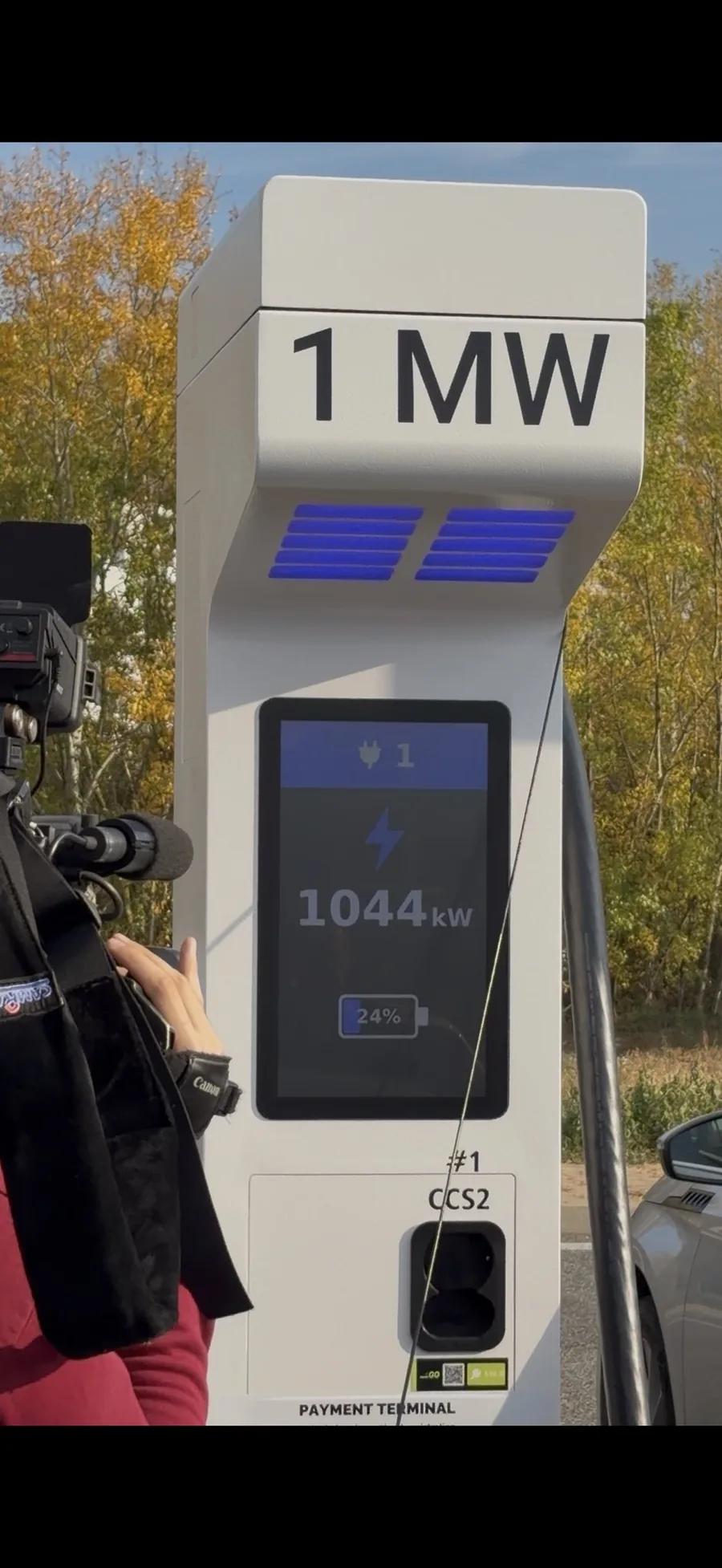
A Slovak charging network has put a public CCS2 connector rated at up to 1.2 megawatts on a motorway rest area outside Bratislava. At the opening, a DENZA Z9 GT peaked at 1,044 kW. The demonstration matters for Australia because DENZA already lists that model here, and because it shows how far public DC hardware can go when the car, cable and site are all built for it — not because every CCS2 car can suddenly pull a megawatt.
What happened
On 15 October 2026, ejoin operator launched what it calls Slovakia’s first public charging station with a capacity of 1.2 MW (1,200 kW) and a maximum current of 1,200 A, on the ejoin GO network at the Zlaté Piesky – Východ rest area on the D1 toward Žilina.
The live demonstration car was a DENZA Z9 GT, the BYD Group premium shooting brake that carries the company’s FLASH ultra-fast charging hardware. Photos from the same event thread show the green Z9 GT at the hub and the charger screens during the session.
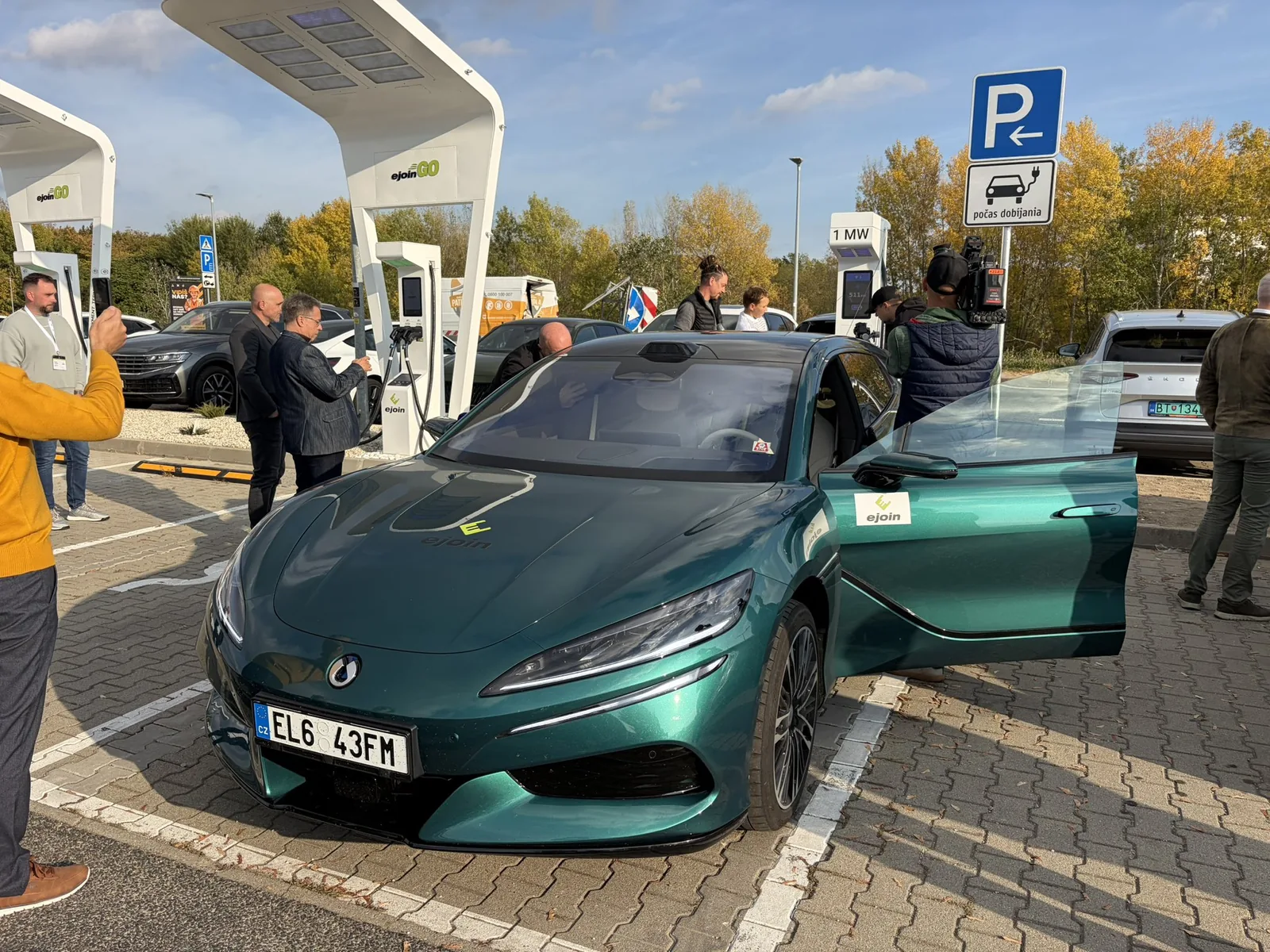
ejoin’s published figures for that session:
| Milestone | Result (ejoin) |
|---|---|
| Start of charge | 14% SoC |
| Above 1 MW | after 30 seconds (18% SoC) |
| Peak power | 1,044 kW at 24% SoC (1 minute in) |
| Still ≥1 MW | until 38% SoC (just over 2 minutes) |
| 50% SoC | 3 minutes, still at 875 kW |
| 20–80% | 6 minutes |
| 14–80% | 6 minutes 30 seconds |
| 14–100% | 11 minutes 40 seconds |
| Energy delivered | 114.25 kWh |
| Power at 92% SoC | 412 kW |
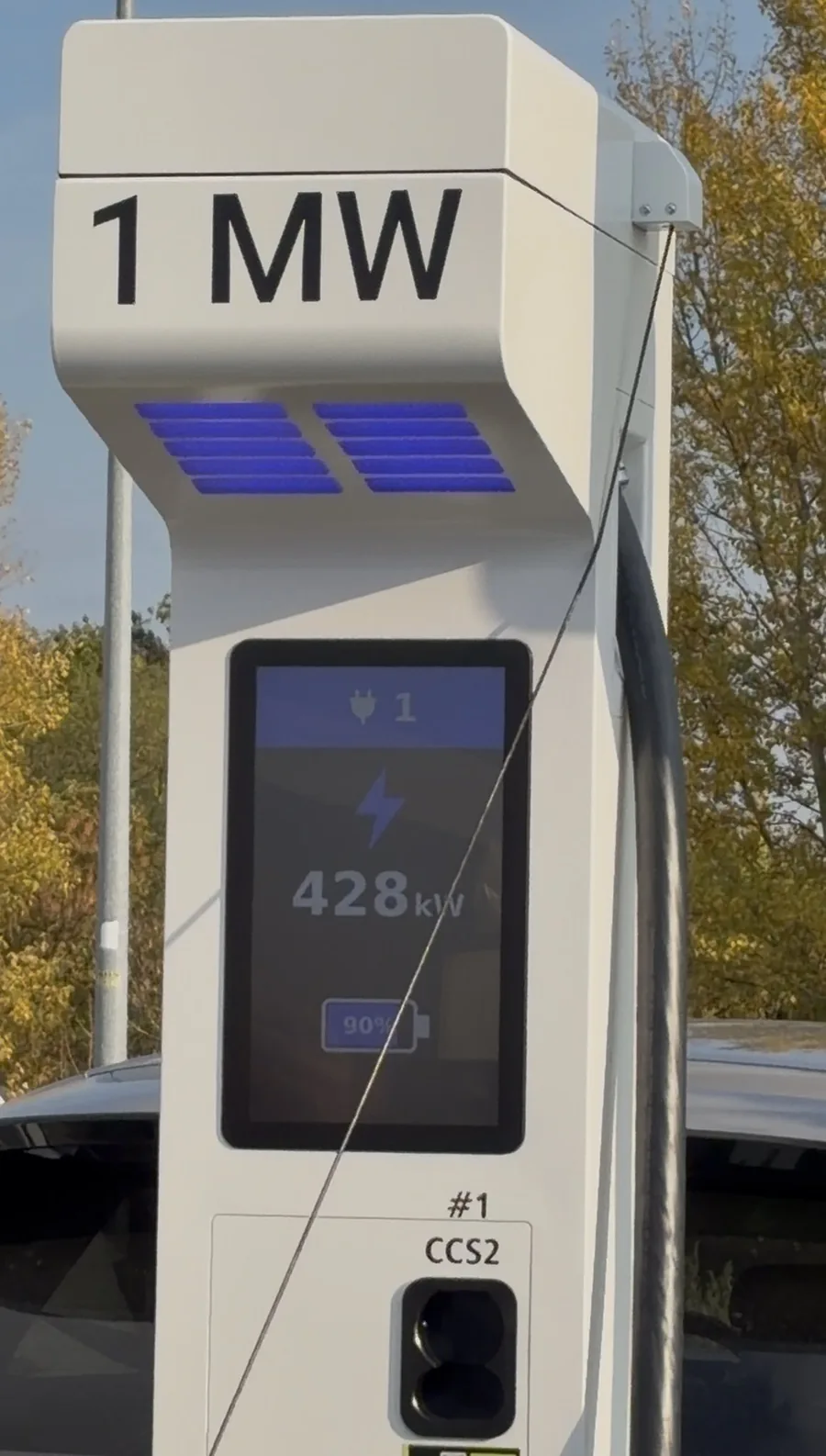
ejoin says this is the highest charging power yet recorded for an electric car on a public station in Europe. That “European record” line is the company’s claim; we have not independently audited other public sites. The session numbers come from ejoin’s press release, and the charger screen photographed at the event showed 1044 kW at 24%.
The connector was still CCS2 — not the separate Megawatt Charging System (MCS) plug used for many heavy trucks. Sharing the CCS2 standard does not mean every existing CCS2 car can take 1 MW. Peak power is limited by the vehicle’s voltage and current capability, the battery’s thermal and cell limits, and the charger and cable ratings. Most cars on Australian roads will remain gated by their own hardware even if a megawatt pole appears nearby. What the Bratislava demo shows is that a production passenger car and a public CCS2 stall can both be engineered high enough to meet in the four-figure kilowatt range.
ejoin also says it is rolling out high-power motorway rest-area hubs (passenger points from hundreds of kilowatts up to this megawatt-class connector, with truck CCS2/MCS at some sites). Exact site-by-site counts in its materials mix named rest areas with “both directions” entries, so we are not repeating a precise total here; the verified core is the public Zlaté Piesky demonstration and ejoin’s stated 1.2 MW / 1,200 A capability.
Registered DC energy on ejoin GO is priced at €0.38 / kWh regardless of charger power (Slovak network price; partner sites may differ).
The car, and the Australian angle
DENZA markets the Z9 GT with FLASH Charging. DENZA’s UK materials quote peaks of up to 1,500 kW and claimed times of 10–70% in five minutes and 10–97% in nine minutes on a roughly 122 kWh pack. Those are manufacturer claims for ideal conditions. The Bratislava public run started from 14% SoC and reached 100% in 11 minutes 40 seconds — a different window, on a public stall, with ejoin’s measured peak of 1,044 kW.
In Australia, DENZA lists the Z9GT as Arriving Soon, with about 850 kW system power, 0–100 km/h in 2.7 seconds, and 10–97% in about nine minutes. The same page quotes 820 km labelled CLTC; European materials quote a lower WLTP figure (DENZA UK: 373 miles / about 600 km for the EV). DENZA Australia has not published an Australian list price. Treat overseas retail prices as foreign-market context only until a local figure appears.
What it means on Australian roads
Public DC power here varies widely by network and site. As one dated example, a January 2026 Australian Government note on Ampol’s Eastern Creek M4 sites described new 400 kW AmpCharge units as among the highest-capacity chargers in the country at that time. Other sites rate lower, and some cars already advertise peaks above that figure: our earlier look at XPeng’s Australian G6 Long Range and Performance grades cited 451 kW peak DC on XPeng Australia’s configurator — still far below 1,044 kW, and still dependent on finding a charger that can deliver it.
So the Australian takeaway is not that megawatt public CCS2 is already here, or that 400 kW is a hard national ceiling. It is that:
- The plug alone is not the upgrade. CCS2 compatibility is necessary but not sufficient; the car, pack and stall must all support the current and voltage.
- Peak needs a matching pole. A FLASH-capable car on a typical highway charger will charge at the charger’s limit.
- DENZA’s local timing is still open. The Z9GT is on denza.com/au as Arriving Soon. Wait for a published Australian price and on-sale date before treating it as a showroom option.
Our take
A public motorway site in Slovakia has demonstrated four-figure kilowatts through CCS2 with a production DENZA that DENZA Australia already teases. That is a verified infrastructure and vehicle pairing, not a promise that Australian highway stops will look the same next month. Watch which cars can actually accept those rates — and which local networks publish stall ratings high enough to use them.
- ejoin, ejoin GO operates Slovakia’s first public 1 MW charging station… (15 Oct 2026)
- ejoin GO charging network / DC pricing
- DENZA Australia, Z9GT
- DENZA UK Media, DENZA confirms UK pricing for Z9 GT (manufacturer claims and UK MRRP only; foreign market)
- energy.gov.au, Ultra-fast EV charging in Western Sydney (29 Jan 2026) (dated Ampol 400 kW example)
- Related on EV Select: XPeng G6 451 kW charging explained
- Witness / photo thread: Radovan Skokan / @slovakevguy, 14 Oct 2026