
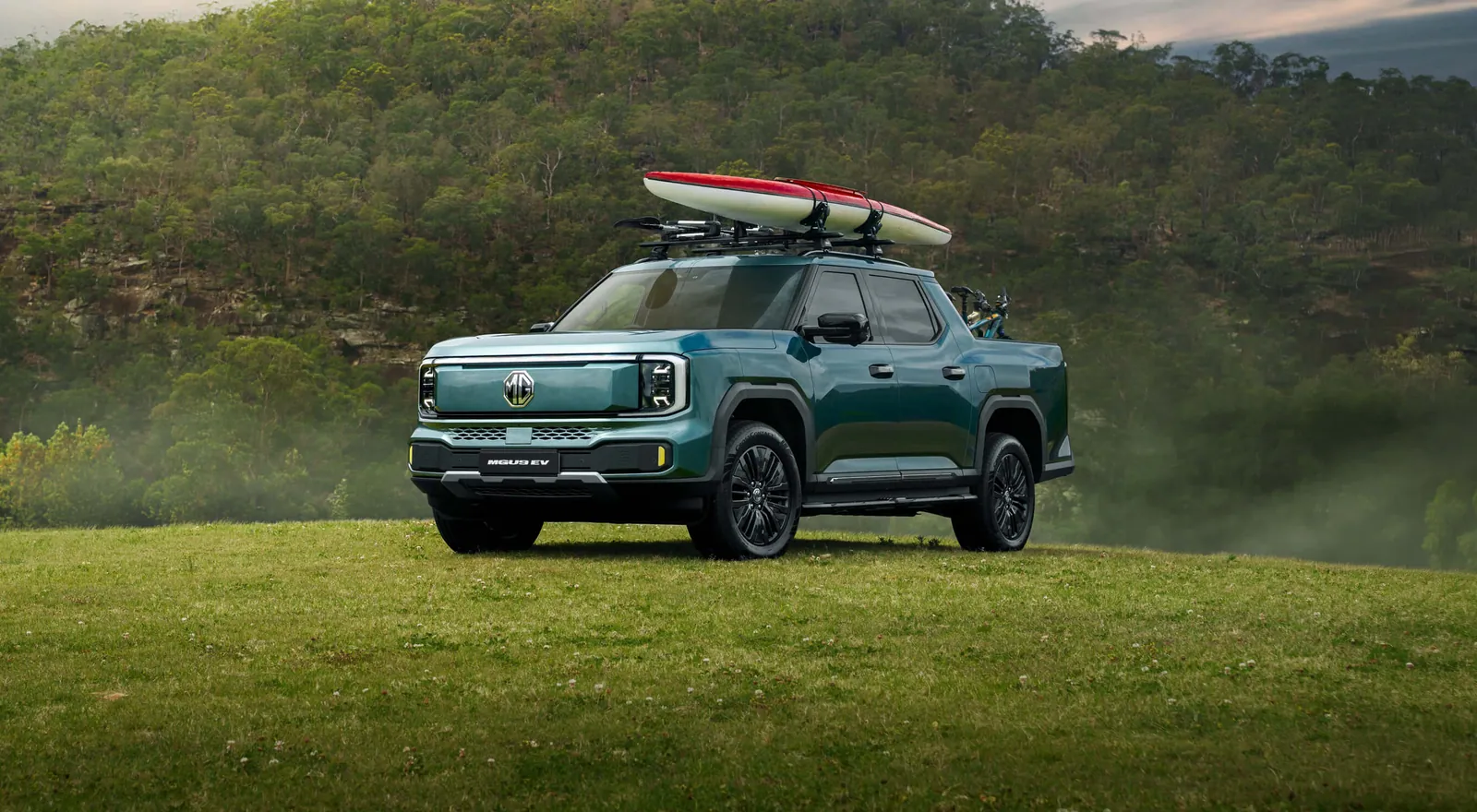
Until recently, an Australian who wanted a battery-electric dual-cab ute from a mainstream brand had two choices: Toyota's HiLux BEV or KGM's Musso EV. MG has now added a third. The MGU9 EV is listed as available now on MG Motor Australia's website, in a single, well-equipped dual-motor grade.
The three are very different vehicles. One is a big, powerful ute built to tow, one is an electric version of Australia's best-known workhorse, and one is the cheapest way into an electric tub. Below we line up each maker's own figures, work out what they say about efficiency and charging, and suggest who each suits. Every number comes from the manufacturers; the calculations are ours.
The three utes, side by side
| MGU9 EV | Toyota HiLux BEV | KGM Musso EV | |
|---|---|---|---|
| Grades | One (dual-motor AWD) | SR cab-chassis, SR pick-up, SR5 pick-up (all dual-motor AWD) | 2WD, 2WD Black Edge, AWD |
| Price | $78,990 list (before on-road costs) | $74,990 / $76,490 / $82,990 (before on-road costs) | $60,000 to $64,700 drive-away |
| Battery | 102.2 kWh LFP | 59.2 kWh | 80.6 kWh |
| Power / torque | 325 kW / 700 Nm | 144 kW combined | 2WD 152 kW / 339 Nm; AWD 266 kW / 630 Nm |
| Claimed range | 430 km (WLTP) | 315 km pick-up, 245 km cab-chassis (NEDC) | 2WD 419 km, AWD 379 km (WLTP) |
| Braked towing | 3,500 kg | 2,000 kg | 2WD 1,800 kg; AWD 2,300 kg |
| Payload | 685 kg | Up to 725 kg pick-up; 855 kg SR cab-chassis | 2WD 905 kg; AWD 805 kg |
| DC charging | 115 kW peak; 20–80% in 42 min | About 30 min on a 150 kW charger (charge window not stated) | 10–80% in about 36 min (300 kW charger) or 46 min (100 kW) |
| AC charging | 11 kW three-phase | About 6.5 hours | 10.5 kW on-board; 0–100% in about 10 h 20 min on 11 kW |
| Power out | 6.6 kW V2L through the charge port, plus three 2.2 kW outlets (tub and frunk) | 1,500 W three-pin outlet in the centre console | External V2L connector |
Sources: MG Motor Australia model page and online configurator; Toyota Australia HiLux BEV press kit (3 July 2026); KGM Australia Musso EV page and MY26 specifications sheet. HiLux premium paint adds $675. KGM's drive-away prices sit alongside a website offer for Musso EVs delivered between 1 September and 31 December 2026, so check the terms with a dealer.
Towing: the MG is in a different league
The MGU9 EV's 3,500 kg braked towing capacity is the headline. That matches the figure most buyers expect from a diesel dual-cab, and it is 1,500 kg more than the HiLux BEV and 1,200 kg more than the Musso EV AWD. If your reason for owning a ute is a caravan, a horse float or a big boat, the MG is the only one of the three on paper that can do the job.
Do not read that number as a promise of distance, though. None of the three makers publishes a range figure for towing, and the claimed ranges in the table are for an unladen vehicle on a laboratory cycle. A heavy trailer adds weight and, more importantly, a lot of aerodynamic drag, so expect the distance between charges to fall well below the claim. The MG's biggest advantage here may be its 102.2 kWh battery: the more energy you start with, the more of a buffer you have when consumption rises.
The MG also brings four-wheel air suspension. MG says the ute lowers itself by 20 mm at 80 km/h and by 40 mm at 120 km/h to cut drag, and can raise its ride height off-road.
Payload: the Musso carries the most
Turn the question around and the order changes. The Musso EV 2WD is rated to carry 905 kg and the AWD 805 kg, more than both rivals. The HiLux BEV pick-up carries up to 725 kg (855 kg for the SR cab-chassis, the best tray option if you want to fit your own body), while the MGU9 EV's 685 kg is the lowest of the group. For tradies who load the tub with tools and materials every day but rarely tow, that matters more than a 3.5-tonne towing figure.
Range: watch the test cycle
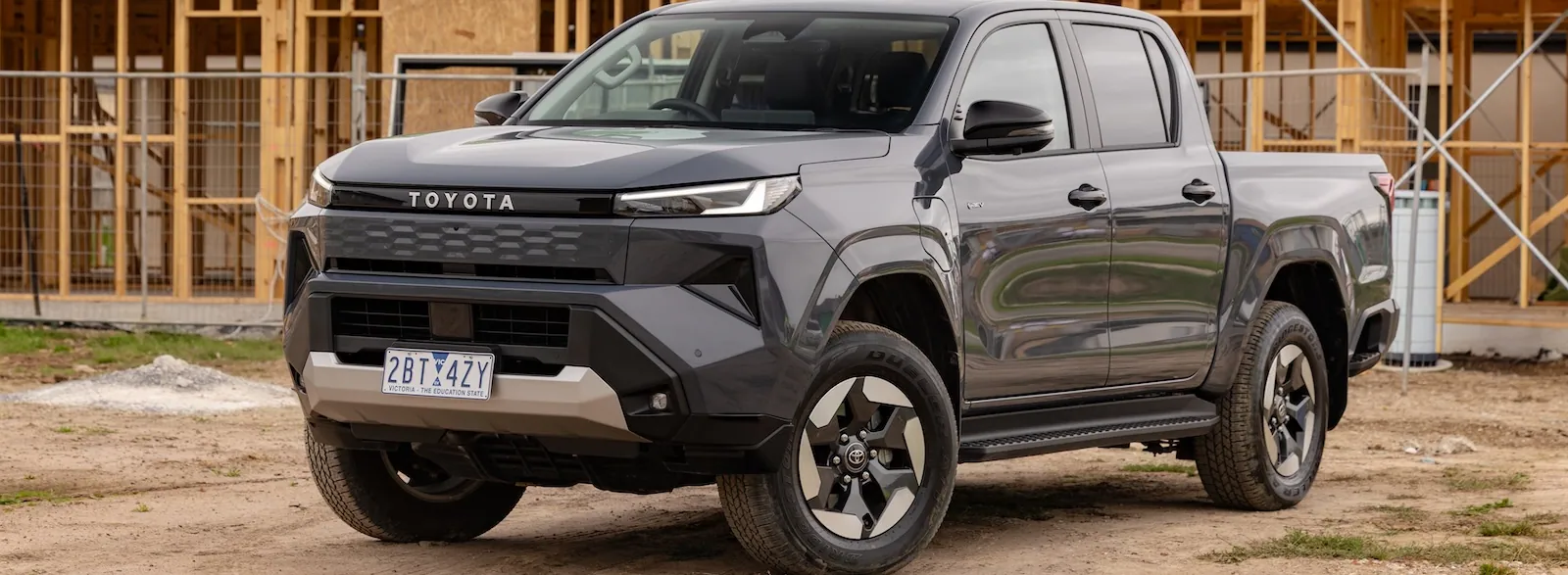
On claimed range the MGU9 EV leads at 430 km WLTP, just ahead of the Musso EV 2WD's 419 km and 51 km more than the Musso AWD. The HiLux BEV's 315 km looks closer than it is. Toyota quotes it on the older NEDC cycle, which Toyota's own footnote says is the test mandated by Australian Design Rule 81/02. NEDC is a gentler test than WLTP, so a NEDC figure tends to read higher than the same vehicle would score on WLTP. The HiLux's real gap to the other two is likely to be larger than the table suggests.
Dividing each battery by its claimed range gives a rough guide to how much energy each maker's figures imply per 100 km:
| Ute | Battery ÷ claimed range | Test cycle |
|---|---|---|
| MGU9 EV | 23.8 kWh/100 km | WLTP |
| Musso EV AWD | 21.3 kWh/100 km | WLTP |
| Musso EV 2WD | 19.2 kWh/100 km | WLTP |
| HiLux BEV pick-up | 18.8 kWh/100 km | NEDC (not comparable) |
This is a blunt measure. It uses the battery figure each maker publishes rather than measured energy use, and ignores charging losses. Still, it shows what you would expect: the MGU9 EV is the biggest and most powerful of the three and uses the most energy per kilometre, and the single-motor Musso is the most frugal of the WLTP-rated pair. The MG simply carries a much larger battery to make up for it.
None of the three has yet been through an independent highway range test that we can cite. When one is published, we will add it to the EV Select database and our highway range guide.
Charging: big battery, modest charger
The MG's peak DC charging rate is 115 kW, and MG quotes 20–80% in 42 minutes. That 60% of a 102.2 kWh battery is roughly 61 kWh, which works out to an average of about 88 kW across the session. KGM says the Musso EV goes from 10% to 80% in about 36 minutes on a 300 kW charger, an average of roughly 94 kW, or about 46 minutes on a 100 kW unit. Despite the MG's bigger battery, the two land in a similar place on a fast charger: around three-quarters of an hour for a useful top-up.
Toyota quotes "approximately 30 minutes" on a 150 kW charger for the HiLux BEV but does not say which part of the battery that covers, so we cannot compare it directly. With a 59.2 kWh battery, the HiLux has the least energy to put back of the three.
At home, the MG's 11 kW on-board charger and the Musso's 10.5 kW unit will only reach those speeds on a three-phase supply. On a typical single-phase home connection, expect a 7 kW wallbox to be the practical limit for all three. Our home charger guide covers the options, and the EV Select charging map shows fast chargers on your route.
Price: the Musso undercuts both
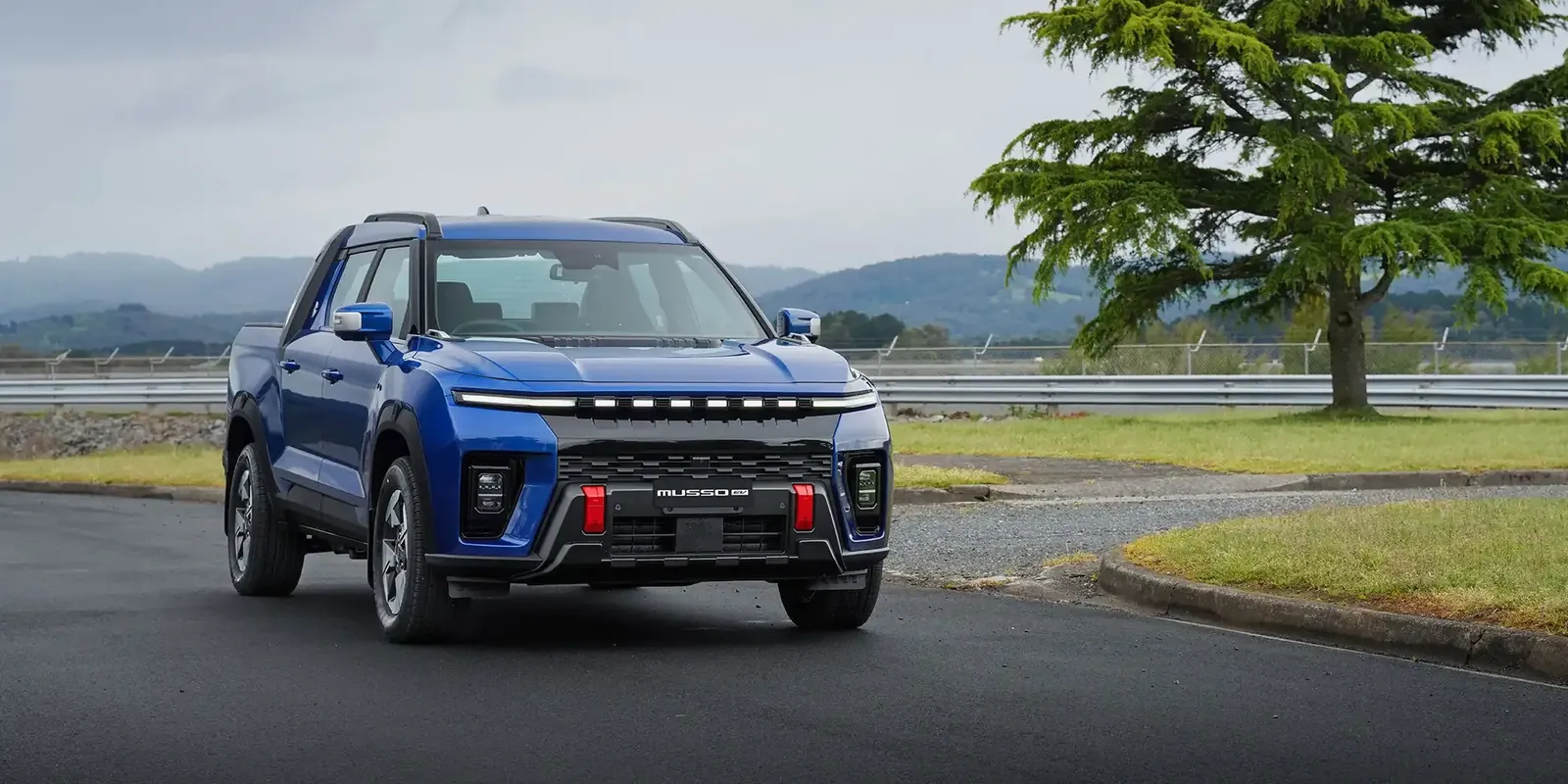
The Musso EV is the clear value choice. KGM advertises it from $60,000 drive-away, while the MGU9 EV's $78,990 and the HiLux BEV's $74,990 to $82,990 are list prices before on-road costs, so the real gap at the dealership is wider than the headline numbers. The MG costs about the same as a mid-range HiLux BEV but has nearly 75% more battery, more than double the power and 1,500 kg more towing capacity.
Warranty is worth checking too. KGM offers seven years with unlimited kilometres. Toyota's standard warranty is five years with unlimited kilometres, and the HiLux BEV's traction battery can be covered for up to 10 years if you have an annual battery health check, plus an eight-year/160,000 km cover if capacity falls below 70%. MG publishes its warranty terms at mgmotor.com.au/warranty; ask the dealer to confirm the battery cover for the MGU9 EV before you sign.
Which one suits you?
- You tow heavy loads: MGU9 EV. It is the only one with a 3,500 kg rating, and its 102.2 kWh battery and air suspension are built around that job. Accept a lower payload and a heavier energy bill per kilometre.
- You carry heavy loads in the tub: Musso EV 2WD. It has the highest payload, the longest WLTP range of the KGM pair and the lowest price. Choose the AWD if you need 2,300 kg towing or traction off the bitumen.
- Your fleet needs a HiLux: HiLux BEV. Toyota says it designed the BEV mainly for mining, business and government fleets and tested it on mine sites. The cab-chassis option, the dealer network and familiar parts are its strengths; range and towing are not.
Australia was also due to get Tesla's Cybertruck, until Tesla cancelled it for Australia and New Zealand. For now, these three are the battery-electric dual-cabs you can order from a mainstream brand here.
Our take
The MGU9 EV is the first electric ute in Australia that does not ask buyers to give up the towing capacity they expect from a diesel dual-cab, and that makes it the most important of the three. The Musso EV remains the sensible, affordable choice for work in town and on the tools, and the HiLux BEV is a fleet vehicle first. Before you buy any of them for towing, wait for independent tests with a trailer attached. Until then, nobody can tell you how far they really go when they're doing a ute's job.
Compare all three, and every other EV on sale in Australia, in the EV Select database.
- MG Motor Australia, MGU9 EV model page
- MG Motor Australia, MGU9 EV online configurator (list price)
- Toyota Australia PressRoom, 2026 Toyota HiLux BEV press kit (3 July 2026)
- Toyota Australia, All-Electric HiLux
- KGM SsangYong Australia, Musso EV
- KGM SsangYong Australia, Musso EV MY26 specifications and features (PDF)