
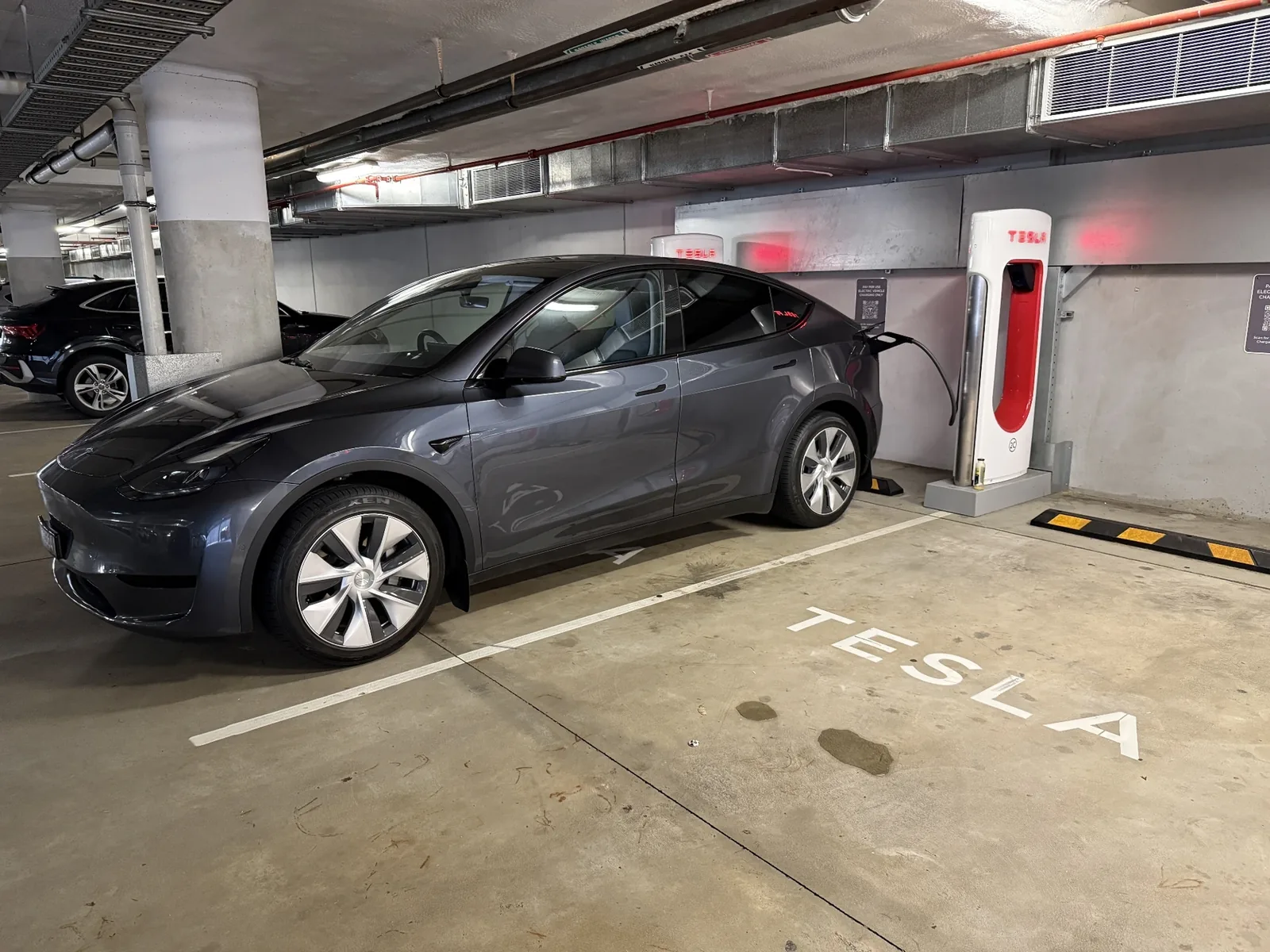
The Electric Vehicle Council, the industry's peak lobby, released analysis by Endgame Analytics on 10 November arguing that EVs can reduce Australia's exposure to oil-driven inflation. The ABS price movements check out. The lower inflation figure is a hypothetical reconstruction, not something the Bureau measured.
What the ABS shows
In the 12 months to September 2026, the ABS published headline CPI of 4.3%. The all-groups index was 104.34 (September 2025 = 100), or 4.34% unrounded — the figure Endgame uses. The Bureau rounds the published rate to 4.3%.
ABS Table 3 confirms automotive fuel +23.6% and electricity +12.8%. Table 4 puts fuel's contribution at 0.7702 percentage points, which Endgame rounds to 0.77. Fuel's September 2025 basket share, as its contribution to the all-groups index, was 3.27, matching Endgame. 0.77 points is just under one-fifth of 4.34%.
The ABS says CPI weights stay fixed until the next update, scheduled for January 2027, so EV uptake does not change the published CPI in the short term — a caveat Endgame also records.
The all-electric scenario is a what-if
Endgame says it removed fuel from the CPI basket, replaced it with the electricity needed to cover the same distance, rescaled the basket to 100% and re-ran the past year's ABS price changes. Its table arrives at 3.75%, 0.59 points lower (it also says "around 0.6").
The release calls this "an illustrative scenario, not a forecast of overnight adoption" and "a what-if comparison, not a measured effect." It covers fuel and charging only. Vehicle prices and flow-on effects such as freight are excluded.
Endgame Analytics director Martin Chow said: "Our estimate compares the cost of petrol for household driving with the cost of the electricity needed to cover the same distance in an EV. It assumes charging costs 80% less than petrol, and excludes vehicle purchase prices and indirect effects, such as freight."
Household bills — and a cheap charging assumption
Endgame's example is a small petrol SUV driven 15,000 km a year. At the ABS petrol price it cites for September 2025 — $1.81 a litre, matching the Bureau's September quarter 2025 quarterly weighted average for unleaded 91 (181 cents) — the fuel bill is about $1,870. A 23.6% rise adds $442 (1,870 × 0.236 = $441). Charging an EV the same distance, "80% less," is about $374; a 12.8% electricity rise adds $48 (374 × 0.128 = $48).
That 80% saving rests on 80% home charging at $0.08 per kWh on an "EV tariff" and 20% public charging at $0.70 per kWh. Eight cents is an assumption — a cheap off-peak or solar EV rate, not a typical flat tariff.
From those rates and the $374 bill, the implied blend is 20.4 cents/kWh. If the same electricity were all charged at the $0.70 public rate, the annual bill would be about $1,283, and a 12.8% rise would add about $164. All at $0.08, it would be about $147. Those figures are EV Select's calculations from Endgame's stated assumptions, not Endgame's.
Purchase prices, and a promotional $19,990
The EVC says base list prices for the ten best-selling EVs fell by an average of 3.1%. The same release dates that fall as both "the year to September" and November 2025 to November 2026; we cannot resolve that from the text. The cheapest new EV is given as $19,990 driveaway, unnamed. BYD's offers page lists a promotional drive-away of $19,990 for the Atto 1 Essential, for retail orders from 15 September to 15 December 2026, delivered by 31 December; metallic paint costs extra. That is a time-limited offer, not an open-ended list price. The EVC also says more than 500,000 battery-electric vehicles are on Australian roads — its figure, not an ABS one.
EVC chief executive Julie Delvecchio said: "Petrol and diesel prices aren't just hurting motorists at the bowser. They're adding to inflation across Australia." And: "Getting more Australians into EVs faster is good economic policy. That means keeping the New Vehicle Efficiency Standard strong, maintaining the FBT exemption and building more chargers."
A government bill that includes phased changes to the FBT electric-car exemption, the Treasury Laws Amendment (Tax Reform No. 4) Bill 2026, passed the House on 29 October. The official bills homepage still listed it as before the House, with no Senate introduction recorded, when we checked on 10 November. It is not yet law.
See also our earlier petrol versus EV running-costs piece.
Confirmed vs modelled
| Item | Status | Source |
|---|---|---|
| Headline CPI 4.3% (index 104.34 ⇒ 4.34% unrounded) | CONFIRMED | ABS CPI Sep 2026 Table 1 / key statistics |
| Automotive fuel +23.6%; electricity +12.8% | CONFIRMED | ABS Table 3 |
| Fuel contribution 0.7702 ppt (EVC: 0.77) | CONFIRMED | ABS Table 4 |
| Fuel share of basket Sep 2025: 3.27 | CONFIRMED | ABS Table 3 index-points contribution |
| Unleaded 91 quarterly weighted average Sep qtr 2025: 181c/L | CONFIRMED | ABS CPI Sep qtr 2025 |
| Weights fixed until Jan 2027 update | CONFIRMED | ABS Sep 2026 release |
| Illustrative CPI 3.75% / −0.59 ppt if all household driving electric | MODELLED | Endgame for EVC; what-if, not measured |
| $1,870 / +$442 vs $374 / +$48 | MODELLED (arithmetic consistent) | Endgame; 80/20 mix at $0.08 / $0.70 |
| $0.08/kWh home rate | ASSUMPTION | EVC "EV tariff"; not a typical flat rate |
| All-public ~$1,283 / +$164; all-home ~$147 | EV SELECT CALCULATION | From EVC's stated rates and $374 bill |
| Top-10 EV base list prices −3.1% | EVC ANALYSIS | Date conflict: "year to September" vs Nov 2025–Nov 2026 |
| Cheapest new EV $19,990 drive-away | CONFIRMED as promo, named | BYD Atto 1 Essential offer, ends 15 Dec 2026 |
| 500,000+ BEVs on roads | EVC-STATED | Not independently counted here |
| FBT bill Senate progress | NOT ESTABLISHED — no Senate introduction recorded | Passed House 29 Oct; APH status still Before Reps when checked 10 Nov |
Sources
- EVC / Endgame media release, 10 Nov 2026 13:52 AEDT: https://newshub.medianet.com.au/2026/11/evs-are-helping-fight-fuel-driven-inflation-new-analysis-finds/180994/
- ABS CPI Australia, September 2026 (released 28 Oct 2026): https://www.abs.gov.au/statistics/economy/price-indexes-and-inflation/consumer-price-index-australia/latest-release
- ABS media release, 28 Oct 2026: https://www.abs.gov.au/media-centre/media-releases/cpi-rose-43-year-september-2026
- ABS CPI, September quarter 2025 (unleaded 91 quarterly average): https://www.abs.gov.au/statistics/economy/price-indexes-and-inflation/consumer-price-index-australia/sep-quarter-2025
- ABS 2025 CPI weight update (automotive fuel 3.35% at Dec 2024 prices): https://www.abs.gov.au/statistics/economy/price-indexes-and-inflation/annual-weight-update-cpi-and-living-cost-indexes/latest-release
- BYD offers (Atto 1 Essential $19,990 drive-away): https://bydautomotive.com.au/offers
- Treasury Laws Amendment (Tax Reform No. 4) Bill 2026 (APH / ParlInfo r7566): https://parlinfo.aph.gov.au/parlInfo/search/display/display.w3p;query=Id:legislation/billhome/r7566
- EV Select, home charging costs: https://evselect.com.au/articles/cost-to-charge-ev-at-home-victoria-2026
- EV Select, petrol vs EV running costs: https://evselect.com.au/articles/ev-boom-inflation-fuel-prices