
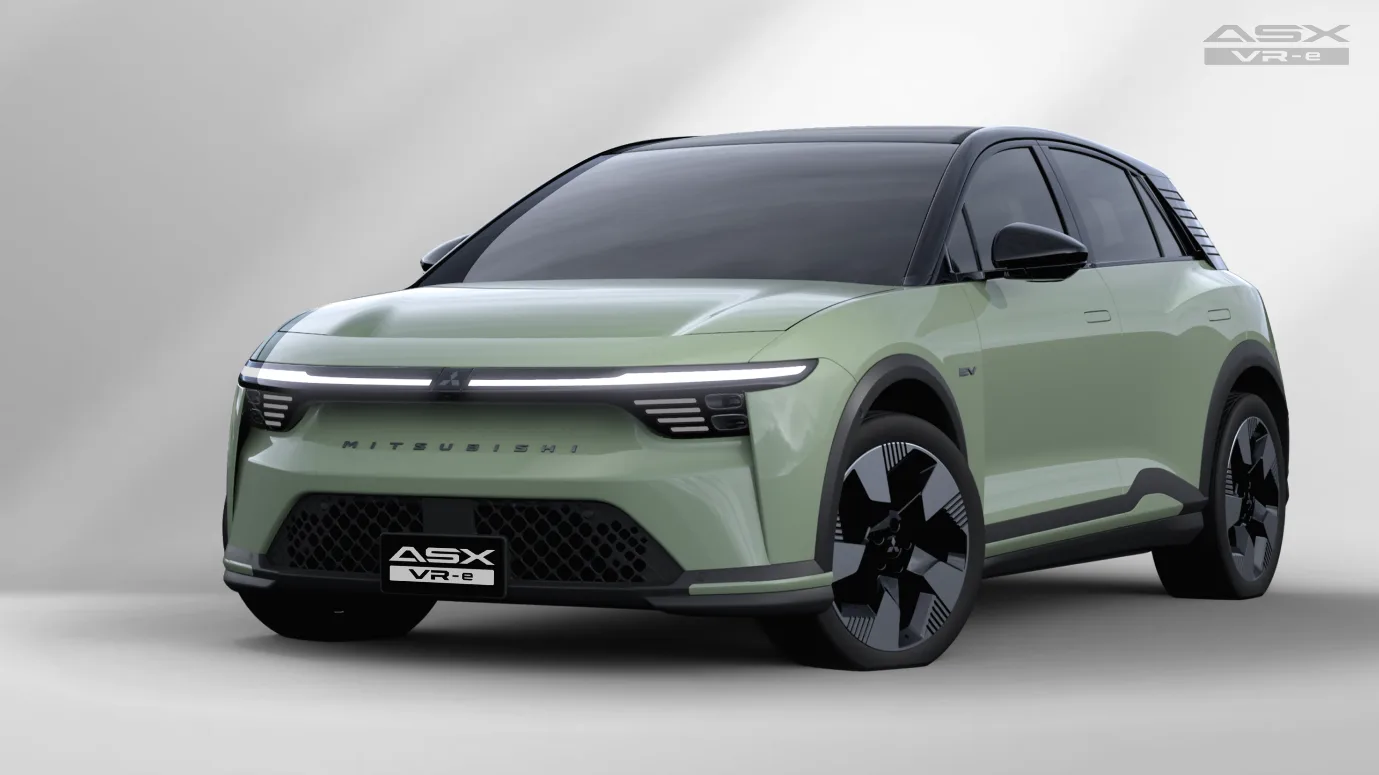
Mitsubishi has sold electrified cars in Australia for well over a decade, but almost all of them have had a petrol engine as well. The ASX VR-e changes that. It is a battery-electric small SUV that Mitsubishi says will go on sale here and in New Zealand before the end of 2026, and its Australian web page already lists all four grades in detail.
What the page doesn't list is a price or a driving range. Those two numbers will decide whether the ASX VR-e matters, so this piece sets out what Mitsubishi has confirmed, how those figures compare with the small electric SUVs you can already buy, and what that tells us about where the price has to land. Every specification comes from Mitsubishi; the comparisons and calculations are ours.
What Mitsubishi has confirmed
- Where it comes from. Mitsubishi's global announcement says the ASX VR-e is supplied by Foxtron, the car-making arm of the Foxconn group, and that Mitsubishi's own engineers tested it on local roads and gave it its own suspension tune.
- Four grades. LS, Aspire and Exceed have a single motor driving the rear wheels. The GSR adds a second motor for all-wheel drive.
- One battery. Every grade uses a 57.7 kWh lithium iron phosphate (LFP) battery.
- Charging. CCS2 DC fast charging at up to 134 kW and Type 2 AC charging at up to 6.6 kW.
- Performance. Mitsubishi quotes 0–100 km/h in 3.9 seconds for the GSR, a figure more often seen on performance cars than on small SUVs.
- Warranty. It is covered by Mitsubishi's 10/10/10 program, the brand's conditional 10-year warranty, servicing and roadside package, which depends on servicing within the Mitsubishi dealer network.
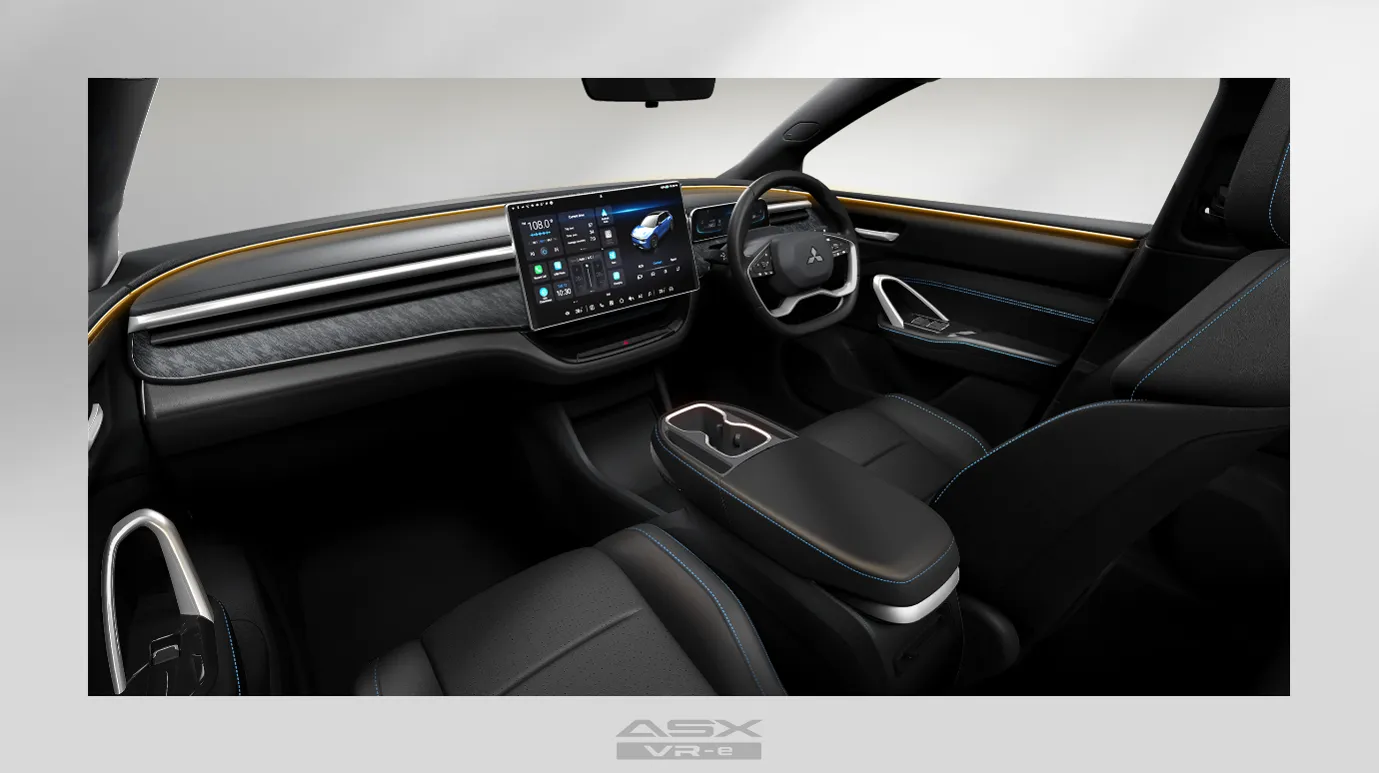
The equipment walk is generous for a small SUV. Even the LS gets a 15.6-inch touchscreen, a 9.2-inch digital instrument display, dual-zone climate control, automatic high beams and a full one-pedal driving mode. The Aspire adds heated and ventilated front seats, a powered front boot, a 360-degree camera and front sensors. The Exceed brings 20-inch wheels, a panoramic glass roof, a 12-speaker SEAS sound system and a hands-free tailgate, and the GSR adds the second motor and two-tone paint.
How it compares on paper
We lined the ASX VR-e up against six small electric SUVs in the EV Select database that sit roughly where it is likely to compete: the established legacy-brand options and the Chinese and European models that have arrived in the past two years.
| Model | Price | Battery | WLTP range | Peak DC | Peak DC ÷ battery |
|---|---|---|---|---|---|
| Mitsubishi ASX VR-e (all grades) | TBC | 57.7 kWh | Not yet published | 134 kW | 2.3 |
| Kia EV3 Air | $47,600 | 58.3 kWh | 436 km | 100 kW | 1.7 |
| Hyundai Kona Electric Standard Range | $46,000 | 48.6 kWh | 370 km | Not yet published | — |
| Skoda Elroq 60 Select | $49,990 | 63 kWh | 395 km | 165 kW | 2.6 |
| Volvo EX30 Plus Single Motor | $49,990 | 69 kWh | 462 km | 153 kW | 2.2 |
| BYD Atto 3 Evo Dynamic | $41,990 | 60.48 kWh | 420 km | 110 kW | 1.8 |
| Leapmotor B10 Design Long Range | $41,990 | 67.1 kWh | 434 km | 168 kW | 2.5 |
Prices are the base prices recorded in the EV Select database on 5 November 2026, before on-road costs unless that maker only quotes drive-away. "Peak DC ÷ battery" is our rough guide to how hard each car can charge relative to its battery size: higher generally means a faster top-up, although the shape of the charging curve matters more than the peak. A dash means the maker has not published a peak DC figure we could verify.
Three things stand out.
The battery is mid-pack. At 57.7 kWh, the ASX VR-e's battery is almost the same size as the Kia EV3 Air's 58.3 kWh and bigger than the entry Kona Electric's, but smaller than the Elroq 60, EX30, Atto 3 Evo and B10 Long Range. If Mitsubishi's range figure lands near the EV3 Air's 436 km, that would be a respectable result; if it falls well short, the car will look expensive next to rivals with bigger batteries.
The charging hardware is competitive. A 134 kW peak on a 57.7 kWh battery works out to about 2.3 kW per kWh of battery, ahead of the EV3 Air and Atto 3 Evo and close to the EX30. Mitsubishi has not yet said how long a 10–80% charge takes, which is the number that tells you what to expect on a road trip.
Home charging is capped. The 6.6 kW AC limit means a single-phase 7 kW wallbox is as fast as home charging gets, and a three-phase supply won't speed it up. Charging from 10% to full at 6.6 kW would take roughly eight hours before losses, which is fine overnight but rules out quick top-ups at home. Our home charger guide explains what each setup gives you.
Where the price needs to land
Mitsubishi hasn't said, and we won't guess a number. What the table does show is the shape of the market it is walking into. A buyer with about $42,000 can already choose between the BYD Atto 3 Evo and the Leapmotor B10 Long Range, both with bigger batteries. Around $46,000 to $50,000 sit the Kia EV3 Air, the entry Kona Electric, the Elroq 60 and the EX30 single motor. And at the bottom of the market, the Leapmotor B03X now starts below $30,000 drive-away.
On specification alone, the LS looks most comparable with the EV3 Air and the Kona. To win buyers, it needs to start at or below those cars, with a range figure close to theirs. The Mitsubishi badge, a national dealer network and the 10-year warranty program are genuine selling points for buyers who have been wary of newer brands, but they will only stretch a price gap so far. The GSR is a different proposition: a 3.9-second small SUV is rare at any price, and it may find buyers even if it costs well into the $50,000s.
What we're still waiting for
- Australian prices for all four grades, and whether Mitsubishi offers drive-away pricing at launch.
- An official Australian WLTP range for each grade.
- A 10–80% DC charging time.
- Boot and front-boot volumes, and the motor outputs for each grade on the Australian specification sheet.
We will add the ASX VR-e's price and range to its entry in the EV Select database as soon as Mitsubishi Australia publishes them, and add independent highway range results once a test is published.
Our take
The ASX VR-e is a well-equipped, quick and sensibly sized small electric SUV with competitive DC charging and a brand behind it that many Australian buyers already trust. It is not a breakthrough on battery size or home charging. Whether it is a good buy will come down to the price sticker, and with the EV3, Kona, Elroq, Atto 3 and B10 already in showrooms, Mitsubishi has very little room to charge a premium for its badge. If you're shopping for a small EV now and like the look of it, it is worth waiting a few weeks for the price before you sign anything else. Our guide to the cheapest EVs in Australia shows what your money buys today.