

Polestar’s next move down the electric-SUV price ladder is taking shape, but its Australian arrival is now being discussed in terms of late 2028 rather than an imminent showroom launch.
The forthcoming Polestar 7 is a compact electric SUV with European production planned through Volvo Cars. Its local appeal is straightforward: a smaller SUV positioned below the current Polestar 4 could bring the brand into reach of more Australian EV buyers.
What is less settled is the final car. There is no announced Australian starting price, range figure, battery capacity or charging specification in the official material reviewed for this report.
When is the Polestar 7 coming to Australia?
Polestar Australia managing director Scott Maynard told Drive the current expectation is “the back end of 2028”. That makes it roughly a two-year wait from November 2026, with the usual caveat that a vehicle still in development can move on the calendar.
There has been a meaningful change in the local guidance. In a March 2026 interview with CarExpert, Maynard pointed to “the back of 2027” with the possibility of spilling into 2028. The latest late-2028 expectation is later than that earlier Australian indication. It should not, however, be confused with a newly announced delay to Polestar’s global 2028 launch plan.
Polestar’s own July 2025 manufacturing announcement already specified a planned 2028 launch. Its February 2026 product strategy update reiterated that year. The distinction matters: an international launch year is not a confirmed Australian delivery month.
How much could it cost?
Maynard’s guidance to Drive is that Polestar 7 should sit below the current pricing of Polestar 4. Drive lists that model’s starting point at $73,900 before on-road costs.
That is a positioning clue, not an announced Polestar 7 price ceiling or a guaranteed launch offer. Currency movements, specification and the final model line-up could all change the comparison before the SUV arrives.
Drive compares the opportunity with the Tesla Model Y and Zeekr 7X, quoting the latter from $57,900 before on-road costs. That does not mean Polestar has promised a similarly priced 7. For now, calling it a circa-$58,000 SUV would go beyond the available evidence.
Volvo partnership confirmed; SPA3 remains unconfirmed
There is considerably firmer information about the engineering direction. Polestar announced a memorandum of understanding with Volvo Cars to develop and manufacture the 7 at Volvo’s new factory in Košice, Slovakia, ahead of the planned 2028 launch.
The official announcement says the SUV will use a Volvo Cars technology base and group component sharing, including cell-to-body technology, next-generation battery density and performance, and next-generation in-house-developed electric motors. Polestar says it will adapt that technology to deliver its own driving characteristics.
Those are engineering commitments, not a published specification sheet. Polestar has not provided battery capacity, WLTP range, motor outputs or Australian variants in the material reviewed.
CAR magazine suggests Volvo’s SPA3 architecture is the likely foundation, but explicitly says the platform has not been confirmed. Reports linking that platform to 800-volt technology should therefore not be read as confirmation of the Polestar 7’s electrical system or charging performance. The official wording supports a Volvo technology partnership; it does not yet establish every technical detail of the finished vehicle.
Official teasers point to the design direction
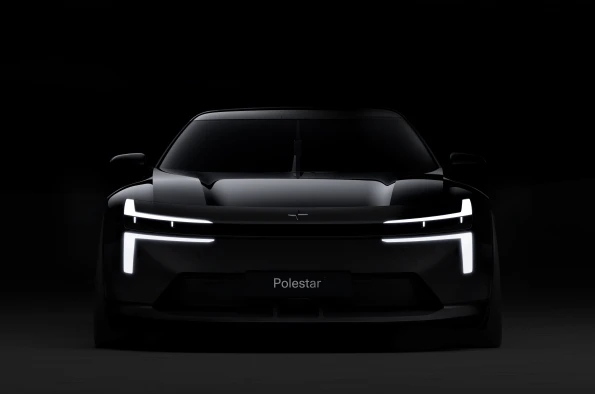
There is an official design lead beyond speculative illustrations. In September 2026, Polestar announced the Formula 2030 concept, saying it would preview design attributes for the next Polestar 2 and the Polestar 7.
Head of design Philipp Römers described the direction as a “bold evolution not revolution”, retaining recognisable elements such as the brand’s Dual Blade headlights. That is a useful indication of the design language, but the Formula 2030 concept is not the production Polestar 7.
Alleged spy photographs are less conclusive. A January report about a camouflaged prototype in China offered competing identifications: the Polestar 7 or a P416 Polestar 4 derivative. Those images do not establish the final 7’s appearance.
Why the smaller SUV matters
Polestar is not presenting the 7 as a replacement for the Polestar 2. The company’s February strategy update lists a new-generation 2 for 2027 and the compact SUV for 2028 as separate products.
For Australians, that means a potential choice between a lower-riding model and a more accessible SUV, rather than simply an existing nameplate changing body style. For Polestar, it is a route into a larger part of the EV market: chief executive Michael Lohscheller said compact SUVs represented approximately one-third of European battery-electric volumes in 2025.
European production also broadens Polestar’s manufacturing footprint. It does not, by itself, prove a lower Australian retail price, a tariff advantage for local buyers or a particular level of standard equipment.
The Australian buyer’s takeaway
The strongest current reading is a compact electric SUV targeted for Australia late in 2028, expected below today’s Polestar 4 pricing, with Volvo engineering and Slovakian production planned. Final pricing, design, dimensions and specifications remain outstanding.
It is a model worth watching for buyers considering the premium end of the compact-SUV market. It is not yet a fully specified or priced alternative to an EV available to buy today.
Global specs and prices: compare the current Polestar line-up across markets on EVChoice, our sister global EV database.
Sources and reporting note
This is an original synthesis of published reporting and manufacturer announcements, not a first-hand interview or vehicle test. Australian timing and price guidance are attributed to Drive; earlier local guidance is attributed to CarExpert. Future product plans may change.
- Drive — Australian timing and price guidance, 8 November 2026
- CarExpert — earlier Australian timing, 3 March 2026
- Polestar — Volvo partnership and Slovakia production, 3 July 2025
- Polestar — model strategy, 18 February 2026
- Polestar — Formula 2030 concept, 7 September 2026
- CAR — engineering reporting and explicit SPA3 caveat, updated 19 February 2026
- EV — disputed prototype identification, 20 January 2026
- Polestar — initial compact-SUV announcement, 16 January 2025
- Polestar — official Polestar 7 landing page